
Rubber foam production is a precisely controlled process. The result is a lightweight, flexible material with excellent performance. Strict raw material proportioning, continuous mixing, controlled foaming, vulcanization curing, and precise post-processing. Those determine the final product’s thermal insulation, flexibility, and durability. Modern standardized production ensures closed-cell rubber foam features low thermal conductivity, high weather resistance, and stable physical properties. It is widely used in HVAC, industrial pipeline insulation, automotive sealing, and construction energy-saving fields. Kingflex professional process control eliminates defective cell structures, density deviations, and performance attenuation, delivering reliable Rubber Foam solutions for global engineering and B2B clients.
Introduction to Rubber Foam Production
Unlike ordinary solid rubber, rubber foam features closed cell structure, excellent thermal insulation, sound absorption, shock resistance, and moisture proof.
The overall performance of rubber foam mostly relies on standardized and refined production processes. Slight changes in raw material ratio, foaming temperature, curing time, and equipment parameters will cause fluctuations in density, cell uniformity, thermal conductivity. For engineering contractors, HVAC system suppliers, and industrial purchasers, the technical logic of rubber foam production helps choice the right materials. This article systematically complete technical process, core control points, and quality standards of rubber foam production.
Core Raw Materials and Formula Design
High-quality rubber foam starts with scientific formula. All raw materials must meet international environmental protection and flame retardant standards.
Complete Technical Production Process
Commercial rubber foam production adopts a fully automated continuous assembly line. Raw material pretreatment, high-precision mixing, constant temperature foaming, vulcanization curing, cooling shaping, and precision cutting. Each link realizes digital parameter control to eliminate manual errors.
➤ Raw Material Pretreatment and Precision Mixing
First, raw materials in constant temperature sealed tanks. According to the preset formula, the automated system conveys all materials to the high-speed mixing for uniform stirring. This stage ensures full fusion, the foundation for uniform cell structure. Uneven mixing will lead to local density differences.
➤ Controlled Foaming and Expansion
The uniformly raw materials are poured onto the conveyor belt. Constant temperature reaction, the blowing agent generates gas, form dense and uniform closed cells. The line controls temperature, expansion speed, and gas release rate to avoid bubble rupture, porosity, or excessive expansion. Mature foaming technology ensures the closed-cell rate of finished products exceeds 90%, effectively blocking heat conduction and water vapor penetration.
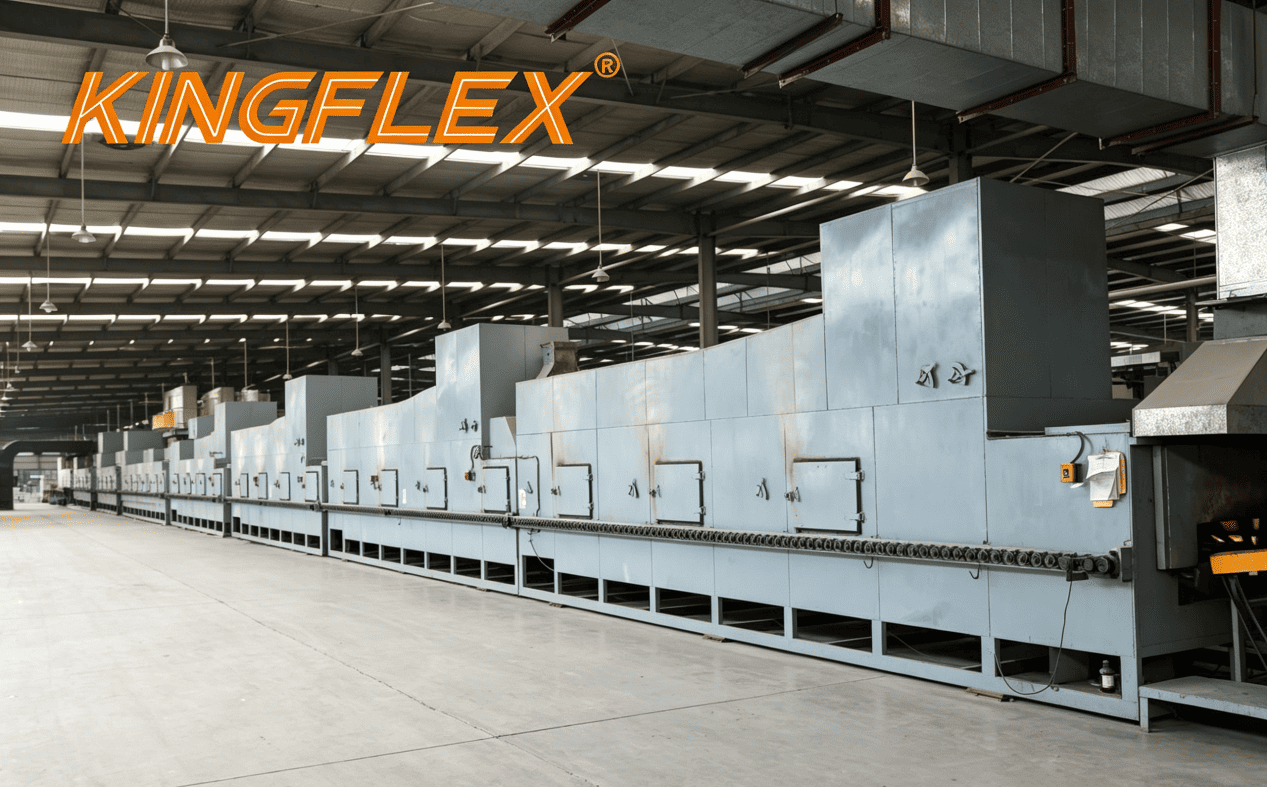
➤ High-Temperature Vulcanization and Curing
Foamed semi-finished products enter the constant temperature curing oven for vulcanization treatment. Through controllable temperature cross linking reaction, the loose cellular structure is solidified, and the polymer molecular chain structure is stabilized. This process improves the elasticity, resistance, and structural stability of rubber foam, preventing deformation and shrinkage. Vulcanization parameters are precisely adjusted according to thickness and density specifications to ensure full curing without aging damage.
➤ Cooling Shaping and Precision Cutting
After curing, the rubber foam is naturally cooled to complete overall shaping. Automated CNC cut equipment is used for cutting and trimming according to customer demand. Standard sheets, rolls, and special shaped accessories. The whole process avoids extrusion deformation and size deviation, ensuring high matching with on-site engineering installation.
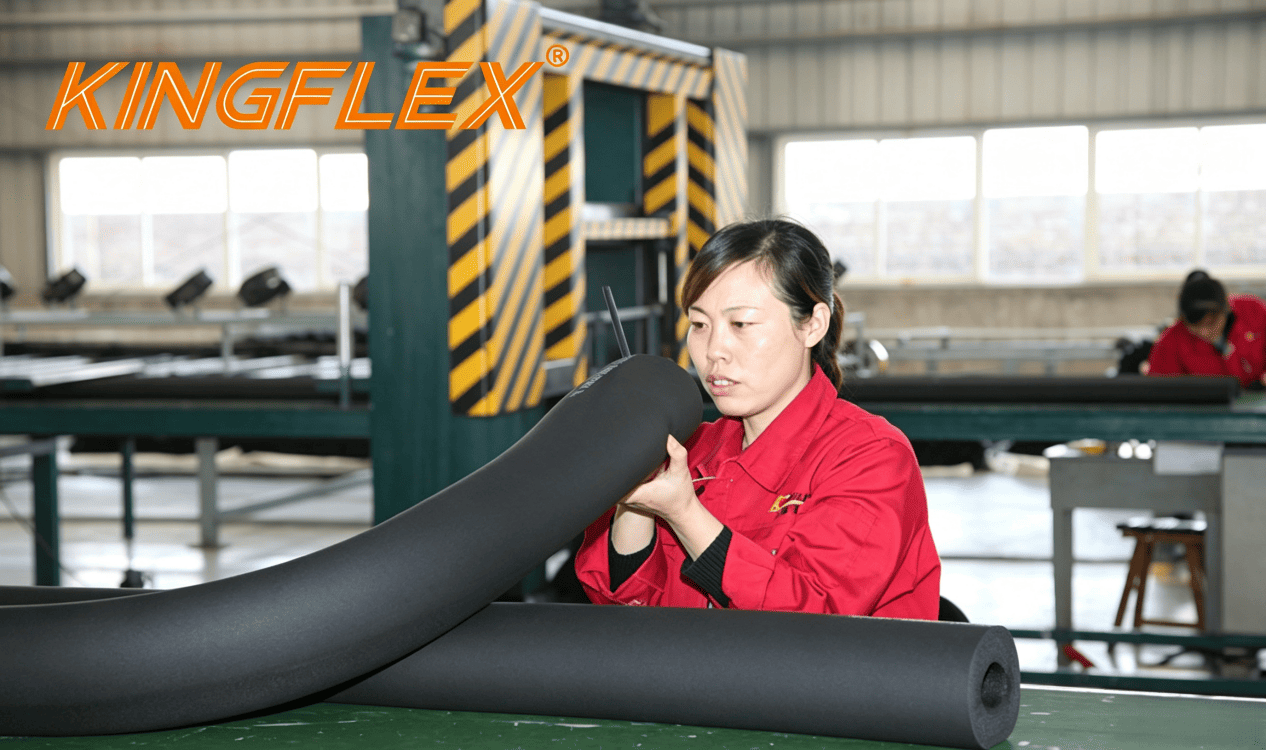
➤ Finished Product Inspection and Packaging
All finished products undergo strict sample inspection, thermal conductivity, density, flame retardancy, compression resilience, and appearance quality. Qualified products are dust and moisture proof packaged to during long distance transportation and overseas storage.
Key Technical Control Points for Stable Quality
- • Cell Uniformity: Strictly control bubble size and distribution to avoid broken cells, ensuring stable thermal insulation performance.
- • Density Consistency: Real time monitoring of batching and foaming parameters to ensure consistent density of each batch of products.
- • Flame Retardant Stability: Fixed additive proportioning ensures that the product permanently meets international flame retardant standards.
- • Anti-Aging Performance: Optimize vulcanization time to resist oxidation and aging in high-temperature and humid environments.
Production Process Matching Application Scenarios
Different process parameters can produce different rubber foam to meet diverse industrial needs. KINGFLEX supports personalized formula and process adjustment to meet the customized production needs of global special engineering projects.
FAQ
Q1: Why does closed-cell rate determine Rubber Foam insulation performance?
A: A high closed-cell rate (over 90%) can lock air inside the material, effectively blocking heat conduction and water vapor penetration. Open or broken cells will cause air convection and moisture infiltration, resulting in decreased thermal insulation performance and mold growth.
Q2: What problems will cause improper vulcanization?
A: Insufficient vulcanization leads to unstable product structure, deformation, and poor compression resilience. Excessive vulcanization make the material hard and brittle, reducing flexibility and service life. Precise time control and temperature are essential.
Q3: How to ensure batch consistency of Rubber Foam products?
A: Fully automated batching and digital process control systems unify formula, foaming, and curing parameters. Strict finished product sampling inspection, batch performance deviation is controlled within the industry standard range.
Rubber foam production is a systematic and precise industrial technology integrating formula design, chemical reaction, and automated processing. Every step from raw material to finished product inspection directly affects the material’s property. Standardized and refined production processes are the core guarantee for high-performance rubber foam products. As a professional rubber foam manufacturer with mature production technology and strict quality control systems, KINGFLEX provides stable, compliant, and high-quality rubber foam insulation materials for global HVAC, industrial energy conservation, and construction engineering projects, supporting one-stop material solutions for various engineering scenarios.
Post time: Sep-18-2026


