
Elastomeric rubber foam insulation, also widely known as closedcell rubber foam, is one of the most functional insulation materials used in modern HVAC, refrigeration, cold storage and industrial piping systems. Many project teams only focus on its anti-condensation feature, but ignoring its critical performance standards, construction specifications and protection rules after installation. Improper installation or wrong grade selection will directly undermine its long term thermal stability, even cause surface cracking, mold growth and insulation failure. As a professional manufacturer Kingflex, we supply Class 0 rubber foam sheets, tubes and foil-faced rubber foam products, complying with international fire, thermal and environmental standards. This guide breaks down the core technical indicators, standard requirements and step-by-step useful installation practices, helping engineers and contractors make compliant, durable insulation solutions for global projects.
1. Core Performance Standards of Elastomeric Rubber Foam
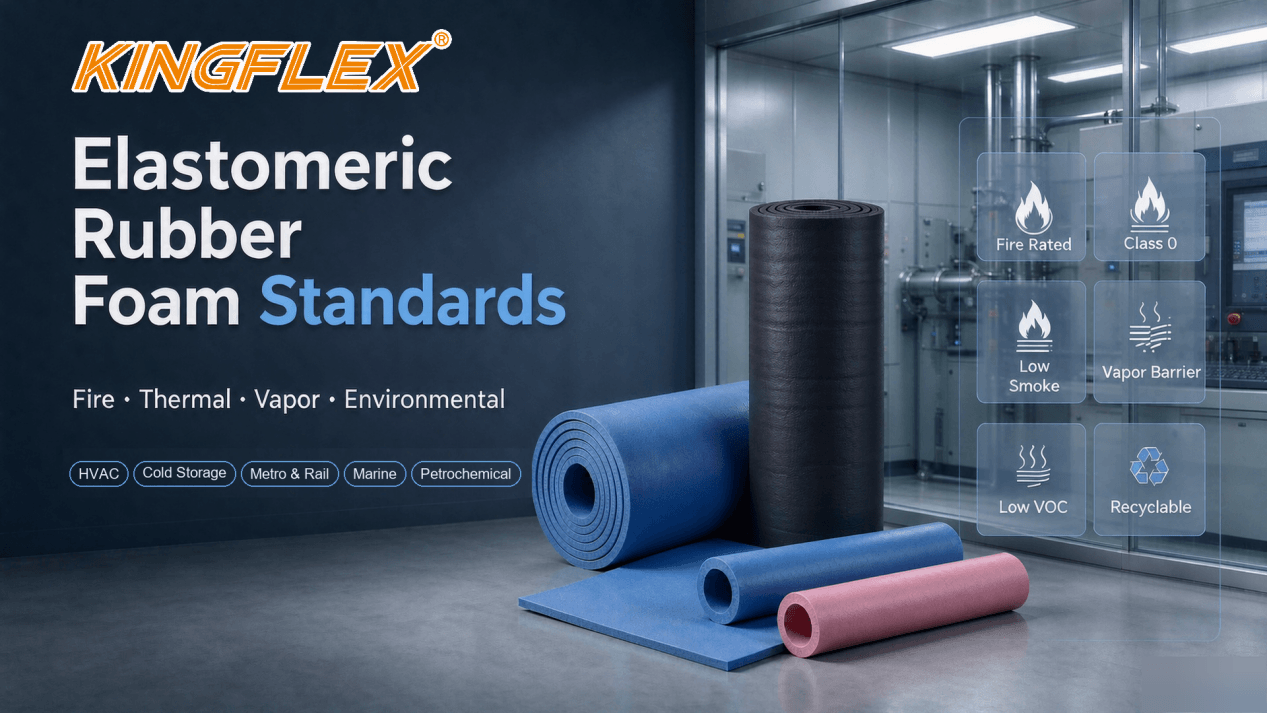
When evaluating rubber foam insulation for overseas projects, four standards are most frequently checked by specifiers and third party inspectors: fire classification, thermal conductivity, water vapor transmission rate and environmental certification.
First, fire performance. Class 0 is the most widely accepted grade for commercial HVAC systems in many regions. It meets strict flame spread and smoke emit limits, which is essential for hotels, shopping malls, data centers and public buildings. It is necessary to note that Class 0 is a UK based standard, while EU projects often refer to EN 13501-1 classification. Different regional codes require different fire grades, so contractors should confirm local building codes before ordering.
Second, thermal conductivity. Reliable rubber foam maintains low λ value under operating temperature range. Typically, the thermal conductivity is ≤0.032 W/(m·K) at 0℃. Stable thermal performance will not change quickly in continuous low temperature service, which is the foundation of energy saving for refrigeration pipelines.
Third, water vapor permeability. The closed cell structure gives rubber foam a low water vapor transmission rate. This is the reason why rubber foam resist condensation. Unlike fibrous insulation, it does not rely on extra vapor barrier jackets in most indoor working conditions. But for ultra-low temperature cold chain applications, reinforced foil facing is still recommended for extra protection.
Fourth, low volatile organic compounds. Green building projects such as LEED require low VOC insulation materials. Qualified elastomeric rubber foam should not release harmful volatile substances, safety for indoor spaces.
2. Proper Installation Steps & Common Mistakes
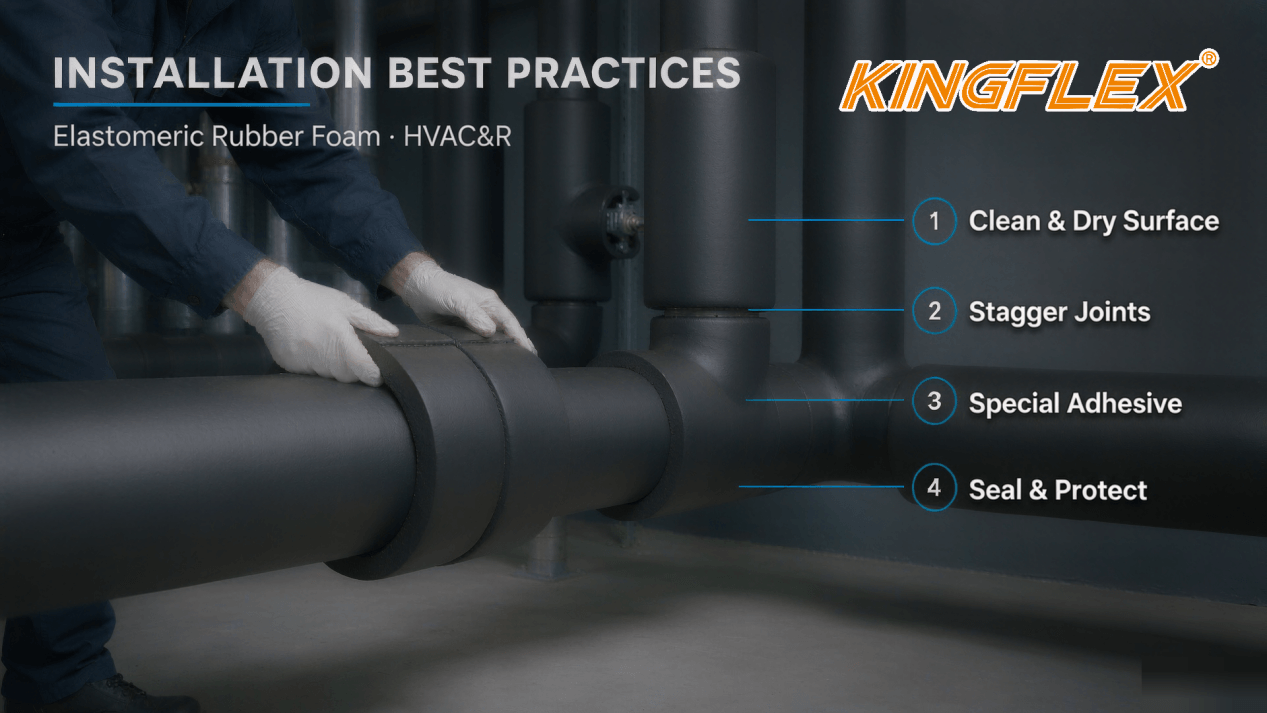
Even high quality Class 0 rubber foam will lose if installed incorrectly. The whole installation workflow can be divided into surface preparation, cutting, bonding, joint sealing and outer protection. Before installation, the pipe or equipment surface must be clean, dry and free of oil, dust or rust. If the surface is wet or greasy, the adhesive won’t stick properly.Then it peels off and leaves gaps. Cut rubber foam tubes and sheets with a sharp, dedicated knife. Clean and straight cuts are critical. Jagged edges create tiny gaps for vapor penetration. Don’t let the joints line up,they should always be offset from each other.Put the adhesive on both surfaces evenly.Wait a bit, then press them together firmly.Don’t use the wrong glue.It can corrode the foam and make it shrink.After bonding, seal every seam with the tape.For outdoor or high humidity spaces, install aluminum foil cover to block UV radiation. Direct sunlight will age ordinary rubber foam rapidly, leading to hardening or cracking. The most mistakes we see from global construction sites: too little glue, joints that line up, forgetting to seal the seams, and using indoor foam in outdoor conditions.These mistakes account for over 70% of on site condensation complaints.
3. Matching Product Selection Guide
Kingflex provides three main forms of elastomeric rubber foam to fit different project needs: plain rubber foam tubes for straight pipes, rubber foam sheets for irregular vessels and elbows, and foil-faced rubber foam with aluminum cover for high humidity or outdoor environments. Plain black rubber foam is the good choice for indoor HVAC chilled water pipelines. It is flexible, easy to cut and fit around elbows, tees and valves. Foil-faced rubber foam adds an aluminum layer for vapor resistance and UV resistance. It is widely selected for rooftop units, outdoor piping, swimming pools and cold storage. For special projects that need higher fire ratings or thicker insulation, we offer custom thickness and density options. Our technical team can help you work out the right thickness based on pipe diameter, medium temperature, and ambient humidity.So, you avoid buying more than you need,or ending up with too thin insulation.
4. Long term Maintenance Tips
Rubber foam needs little maintenance, but regular inspection can extend its service life. Project owners should check seams and outer jacketing annually. If the surface is damaged, repair it immediately with right foam pieces and adhesive. Once the inner substrate is exposed to humid air, condensation happens quickly. When you’re checking the equipment, don’t scrape the foam with sharp tools.And stay away from strong cleaners,they’ll break the rubber.If the project is in coastal salt-spray areas, extra protective cover is recommended on top of aluminum foil .
Comparison Table
|
Item |
Elastomeric Rubber Foam |
Fibrous Insulation (Glass Wool) |
| Cell Structure | Closed-cell | Open fibrous |
| Vapor Barrier | Built-in | Requires separate vapor barrier |
| Typical Thermal Conductivity | ≤0.034 W/(m·K) | ≤0.042 W/(m·K) |
| Main Fire Grade | Class 0 / B1 | A1 |
| Suitable Environment | High humidity, anti-condensation priority | High temperature, dry environment |
| Installation | Need special adhesive, seam sealing | Dry lay, no glue required |
FAQ
Q1: Can Class 0 rubber foam be used for high temperature steam pipes?
A: No. Elastomeric rubber foam is designed for chilled water, refrigeration and medium low temperature systems. It is not suitable for high temperature steam piping. High temperature scenarios should choose glass wool or other high temperature insulation materials.
Q2: Is foil-faced rubber foam always necessary?
A: No. For dry indoor HVAC systems, plain rubber foam is good enough. Foil facing is used for outdoor, coastal, high humidity areas.
Q3: How long is the service life of rubber foam?
A: Under proper installation and normal indoor conditions, Kingflex rubber foam can maintain stable performance for more than 15 years. Service life will be shortened under continuous UV exposure and salt corrosion.
Conclusion
Elastomeric rubber foam is not only a simple anti-condensation material. Its value comes from three things: the right grade, local standards, and proper installation.Many procurement teams only compare unit prices, ignoring the hidden risk caused by improper selection and poor construction. Kingflex supplies different rubber foam insulation with complete test reports, supporting global HVAC&R contractors to get reliable, code compliant insulation solutions. If you need technical calculation, sample support or specification datasheet, feel free to contact our engineering team.
Post time: Nov-10-2026


