
When you look at a HVAC system, insulation may not be the first thing that gets your attention. Pipes, valves, chillers, ducts and air-condition equipment are usually the visible parts of the system. Yet the insulation around them plays an important role in keeping the system working efficiently. Elastomeric rubber insulation sheet is widely used for HVAC piping, refrigeration lines, ducts and equipment for flexibility and resistance to moisture.
Unlike rigid insulation materials, elastomeric foam can bend around pipes, fittings and components. But how does it actually work? What Is Elastomeric Foam Insulation?
Elastomeric foam insulation is a flexible material. One of its important characteristics is closed-cell structure. In a closed-cell foam, the individual cells are largely enclosed rather than forming an interconnected open structure. This helps limit the movement of heat and moisture through the material.
NBR/PVC rubber foam is one common type of elastomeric insulation used in HVAC applications. Kingflex thermal insulation board are designed for applications including air-conditioning systems, chilled-water piping, refrigeration and other thermal insulation requirements.
How Does It Reduce Heat Transfer?
The main purpose of insulation is to slow down heat transfer.
Consider a chilled-water pipe. The water inside the pipe may be significantly colder than the surrounding space. Without sufficient insulation, heat from the warmer environment moves toward the cold pipe. That additional heat makes the cooling system work harder.
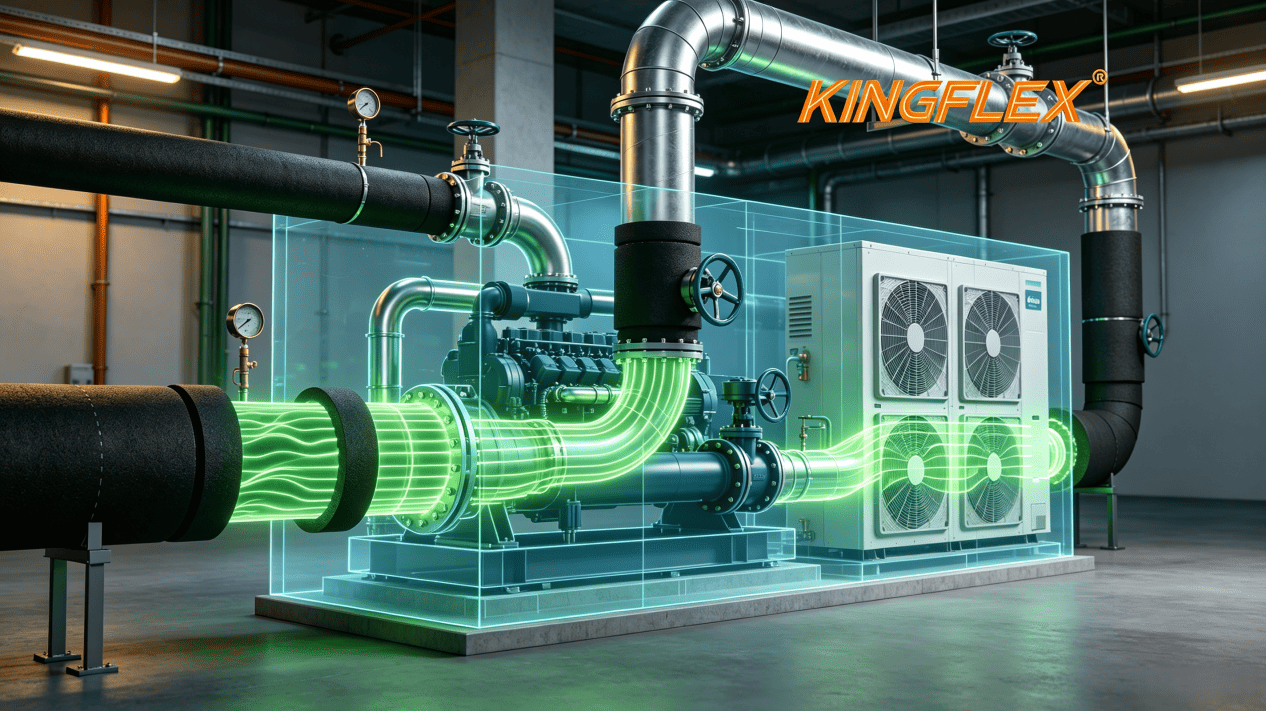
A layer of elastomeric foam creates thermal resistance between the pipe and the surrounding environment. The thicker and more suitable the insulation is for the application, the more effectively it can reduce heat transfer. The actual insulation design, however, still needs to consider operating temperature, pipe size, ambient conditions and required thickness.
Why Is the Closed-Cell Structure Important?
Thermal performance is one of the reasons elastomeric foam is used in HVAC systems. Moisture can be a serious problem. When a cold pipe is exposed to humid air, water vapor can migrate toward the colder surface.
If the insulation cannot sufficiently resist moisture movement, condensation may eventually appear on or inside the insulation system. A closed-cell structure helps make elastomeric foam suitable for this type of application.
Kingflex lists a water vapor permeability of ≤0.91 × 10⁻¹³ kg/(m·s·Pa) and a water vapor resistance factor of μ ≥10,000 for its published NBR/PVC rubber foam tube data. These properties are particularly relevant when insulation is used around chilled-water pipes and refrigeration lines.
Flexibility Matters During Installation
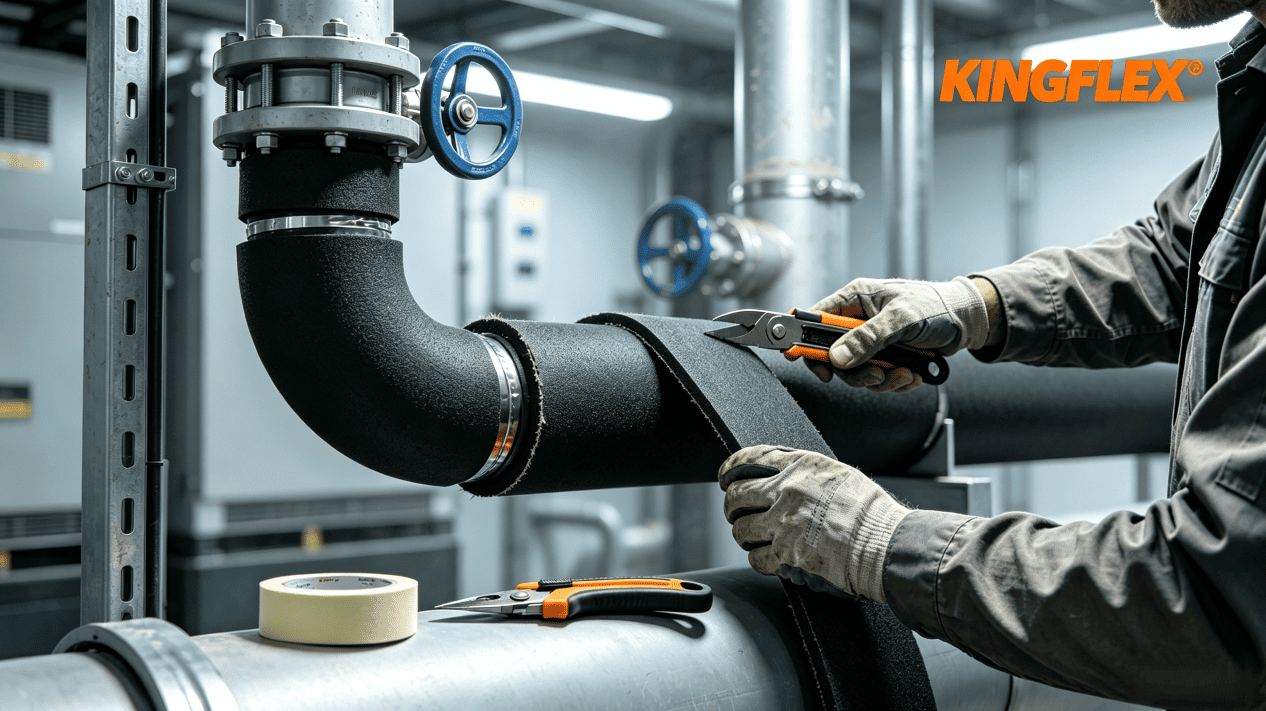
HVAC systems rarely consist of perfectly straight pipes. There are elbows, joints, valves, fittings and changes in pipe direction. A rigid insulation board may require more cutting and shaping around these areas. Flexible elastomeric foam can be cut and fitted around different components more easily. Tube insulation is particularly convenient for standard pipe diameters, while sheet or roll products can be fabricated for larger or irregular surfaces. This is why elastomeric foam is commonly used in both tube and sheet forms.
Where Is Elastomeric Foam Insulation Used?
Typical applications include:
- ✓ Chilled-water pipes
- ✓ Air-conditioning pipes
- ✓ Refrigeration lines
- ✓ HVAC ducts
- ✓ Pumps and equipment
- ✓ Tanks and fittings
- ✓ Commercial air-conditioning systems
- ✓ Industrial piping
The required product and thickness depend on the operating conditions of the system. For example, a small refrigeration line and a large chilled-water pipe may have completely different insulation requirements. Simply choosing the thickest available insulation is not necessarily the best approach.
The Installation Still Matters
Even a good insulation material cannot perform properly if it is poorly installed. Joints, seams, supports and fittings need particular attention. Gaps in the insulation can create thermal bridges and may also become weak points for moisture intrusion.
For cold applications, continuity of the vapor barrier is especially important. That means insulation should be considered as a system, rather than simply a product wrapped around a pipe. Elastomeric foam insulation works by combining several useful characteristics: thermal resistance, closed cell structure, flexibility and moisture resistance. For HVAC contractors and insulation distributors, the choice of insulation should be based on the actual operating conditions rather than simply the material name. Pipe diameter, temperature, humidity, insulation thickness and installation quality all influence the final result.
Kingflex NBR/PVC rubber foam insulation in both tube and sheet/roll formats for different HVAC and thermal insulation applications. Looking for elastomeric foam insulation for an HVAC or refrigeration project? Contact us to discuss product specifications, sizes and application requirements.
Post time: Sep-15-2026


