
Anti-Condensation Guide
When designing HVAC, refrigeration and industrial piping systems, condensation is one of the most common and costly problems. Dripping moisture can ruin ceilings, trigger mold growth, corrode pipe fittings, and pull down the overall energy efficiency of the whole system. This is exactly where closedcell rubber foam insulation, also known as elastomeric foam, stands out. Unlike fibrous insulation materials that rely on air pockets for thermal resistance, rubber foam features a fully sealed closed cell structure. It integrates thermal insulation and vapor barrier in one material, making it the preferred choice for chilled water pipes, refrigerant lines and other low temperature piping worldwide. As a reliable China manufacturer, KingFlex supplies high quality rubber foam tubes and boards suitable for global HVAC and industrial projects.
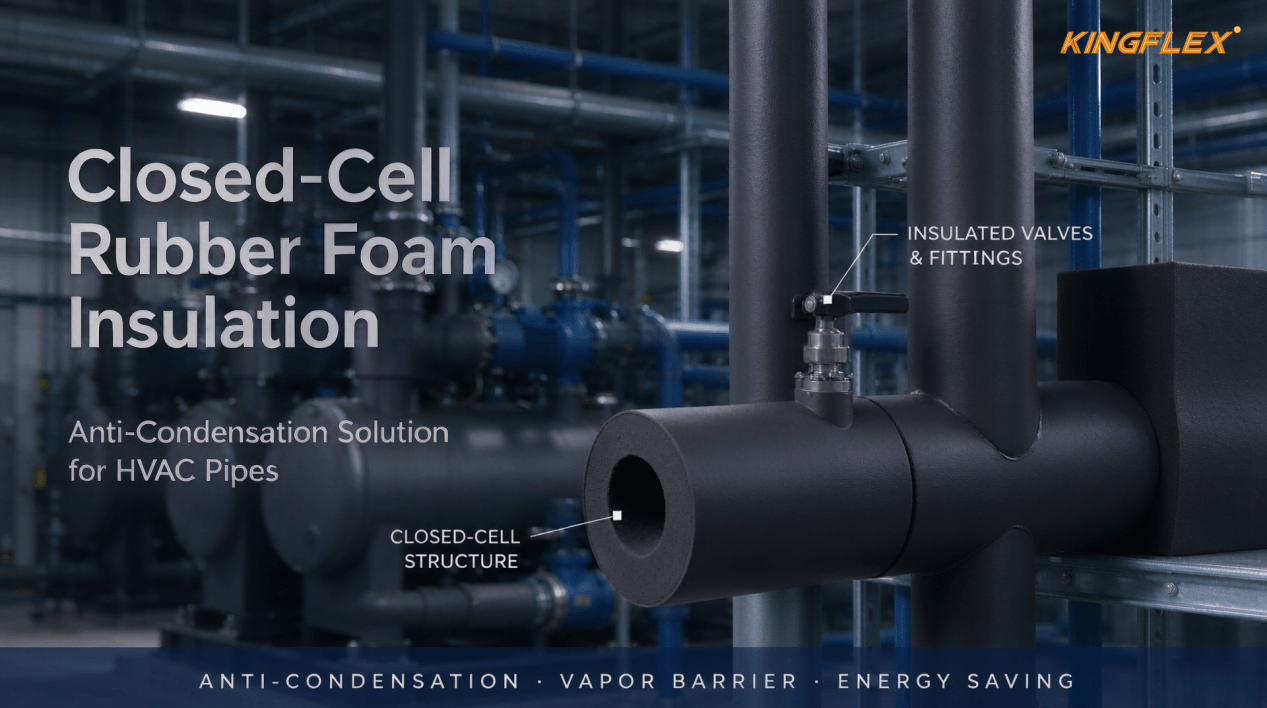
What Is Closed Cell Rubber Foam?
Rubber foam insulation is manufactured from NBR/PVC mixed formula, by continuously foamed into flexible tubes, sheets and rolls. The independent sealed micro cells can form a natural vapor resistant layer, so extra separate vapor barrier wrapping is usually unnecessary for most indoor cold pipe applications. Key core indicators include low thermal conductivity, high closed cell rate, stable fire performance and wide working temperature range. It is fiber free, dust free, and friendly to clean rooms, hospitals and public buildings with strict hygiene requirements.
What sets closed cell rubber foam apart from many fibrous insulation materials is its inherent moisture resistance. Unlike open fibrous insulation that absorbs water vapor and loses thermal performance once get wet, the closed cell structure forms a built-in vapor barrier. It eliminates the need for an extra separate vapor barrier layer in most HVAC and refrigeration piping projects, which greatly cuts down material cost and on-site installation time.
Core Advantages
● Outstanding anti-condensation performance.Closed cell structure blocks water vapor penetration effectively. It stops pipe condensation form even under high ambient humidity, preventing dripping and secondary damage.
● Low thermal conductivity .Thermal conductivity ≤0.034 W/(m·K) at 0℃, minimizing heat loss for cold pipelines and cutting down energy consumption of refrigeration & air conditioning units.
● High flexibility & easy installation .Rubber foam is soft and elastic, fits tightly around elbows, tees, valves, flanges and irregular components. It can be cut on site without complicated tools, reducing construction gaps.
● Reliable fire classification Available in Class 0 / B1 fire performance complying with EU 13501 1 standard, self-extinguishing, low smoke emission ,no dropping for commercial and mechanical room projects.
● Long service life & chemical resistance .Resists ozone, aging and mild chemical corrosion. Kingflex rubber foam can keep stable performance for decades under normal operating conditions.
Typical Application Scenarios
● HVAC chilled water pipes, hot water pipes, VRF refrigerant copper tubes
● Refrigeration, cold storage and low temperature industrial pipelines
● Mechanical equipment, pump and valve insulation
● Clean rooms, hospitals, shopping malls, data center piping systems
● Projects with strict condensation control requirements
Parameter Comparison Table
|
Item |
Rubber Foam Insulation |
| Thermal Conductivity | ≤0.034 W/(m·K) @ 0℃ |
| Closed-cell Rate | >90% |
| Working Temperature Range | -50℃ ~ 105℃ |
| Fire Standard | EU 13501-1, Class 0 / B1 |
| Feature | Built in vapor barrier, flexible, fiber free |
| Main Use | Cold pipe, anti-condensation, irregular fittings |
How to Pair Rubber Foam With Other Insulation Materials
Many HVAC engineers combine rubber foam with glass wool for a complete insulation system. Rubber foam works as the inner layer on chilled pipes to block moisture and condensation from intrusion.On the other hand glass wool is applied externally for extra fire resistance and sound absorption. This dual-layer make a balances of moisture control, fire safety and noise reduction, widely adopted in large mechanical rooms. For large air ducts where condensation risk is low, glass wool is much more cost effective. For cold water piping with high humidity risk, rubber foam remains the primary selection.
FAQ
Q1: Does rubber foam need an extra vapor barrier?
A1: For most standard indoor HVAC chilled pipe projects, rubber foam closed cell structure acts as inherent vapor barrier, extra vapor wrap is not required. For extreme high humidity outdoor conditions, and high UV condition aluminum foil facing is recommended.
Q2: Can rubber foam be used on high temperature ducts?
A2: For rubber foam,its maximum continuous working temperature is 105℃. For high temperature hot air ducts, glass wool or rock wool is more suitable than rubber foam.
Q3: What forms does KingFlex rubber foam supply?
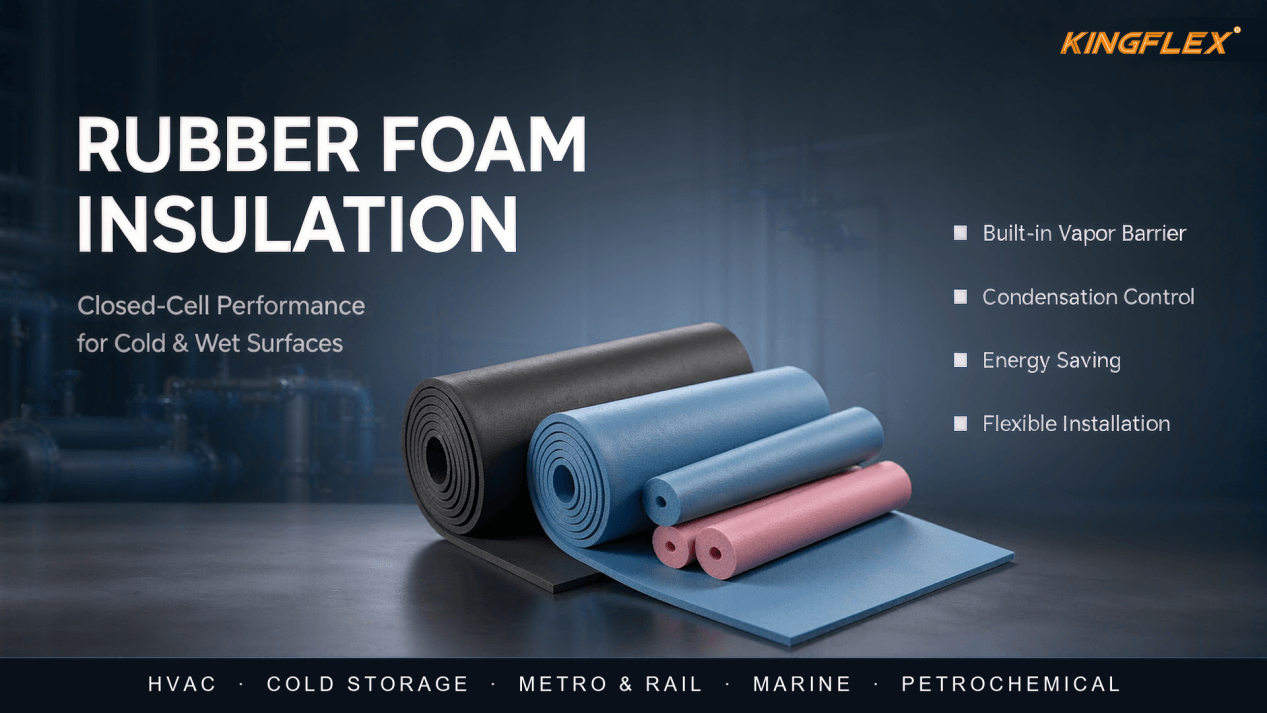
A3: We have Pre-fabricated tubes, flat sheets, rolls, and aluminum foil faced options, and we can supporting OEM & custom thickness.
Conclusion
Condensation control is the core challenge for cold piping insulation, and closed cell rubber foam is designed to solve this problem. Its integrated vapor barrier, flexible installation and stable thermal performance make it irreplaceable in HVAC/R and refrigeration industries. As a professional insulation manufacturer, KingFlex provides matched rubber foam and glass wool products. We supply one stop insulation solutions for contractors, mechanical engineers and building owners worldwide.
Post time: Nov-05-2026


