
When talking about insulation materials, one technical property stands out: Thermal Conductivity, often referred to as the thermal conductivity or λ (lambda) value. At Kingflex, we believe that understanding this single property can save your project thousands of dollars in energy costs over the lifetime of a building or industrial facility. Today, we talk about what thermal conductivity really means and why it should be your first filter when selecting insulation materials.
What Is Thermal Conductivity?
In simple terms, thermal conductivity measures how easily heat passes through a material. The lower the thermal conductivity, the better the material resists heat flow. For example:
· High Thermal Conductivity (poor insulator): Metal – heat flies through it.
· Low Thermal Conductivity (excellent insulator): Kingflex elastomeric foam – heat moves very slowly.
Standard insulation materials typically have thermal conductivity ranging from 0.030 to 0.045 W/(m·K) at 0°C mean temperature. Kingflex products are engineered to achieve consistently low thermal conductivity, ensuring maximum energy saving for your hot pipes or cold ducts.
Why Thermal Conductivity Is the First Selection Criterion
1. Direct Impact on Energy Bills
Every year, poorly insulated HVAC and piping systems waste enormous amounts of energy, meanwhile you will pay mounts of money for them. If you choose a insulation material with a thermal conductivity that is just 0.005 higher than a premium alternative, you could lose 15–20% more heat. For a huge industrial system, that difference translates into tens of thousands of dollars in extra fuel or electricity costs annually.
2. Required Thickness Calculation
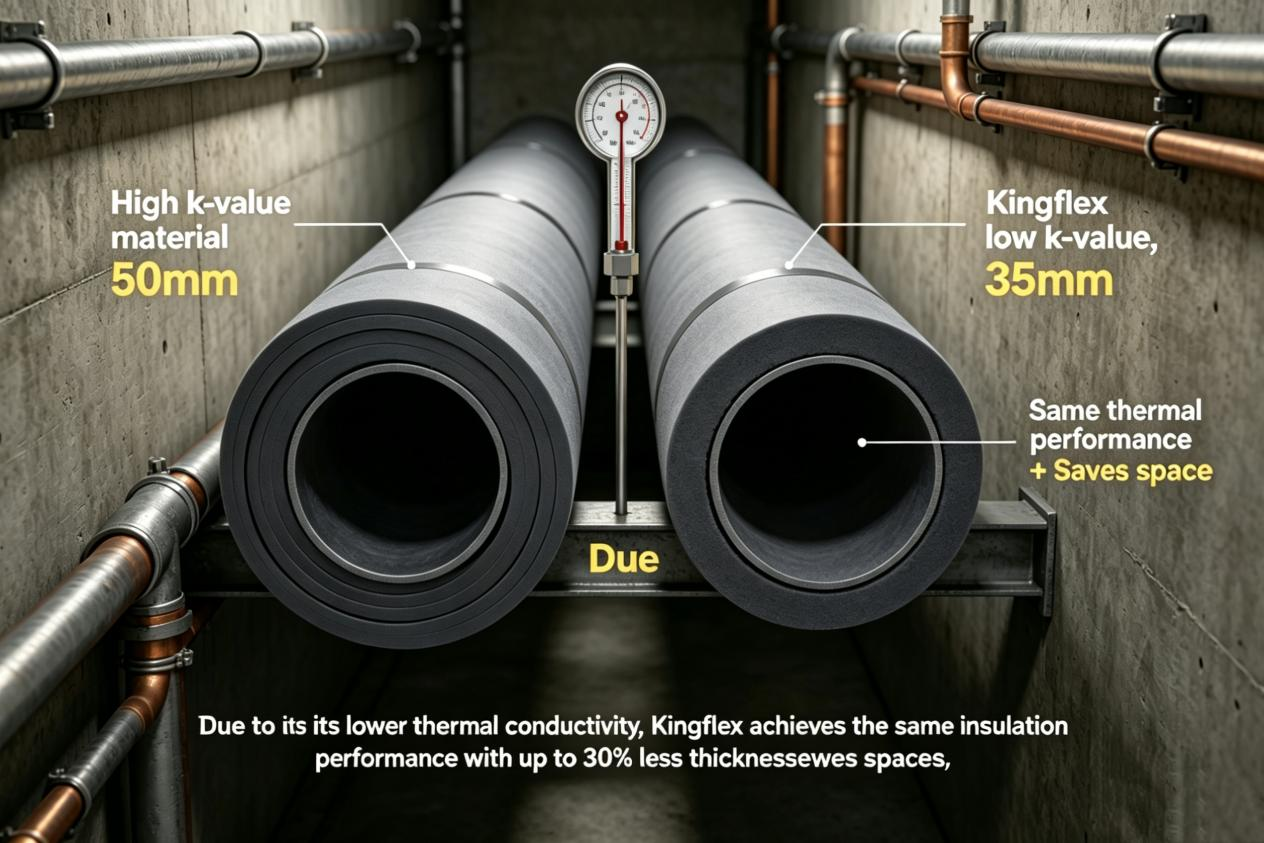
Engineers use the thermal conductivity to calculate how thick the insulation material must be to achieve a target heat loss or surface temperature. A lower thermal conductivity means you can achieve the same performance with a thinner layer. This saves material costs and occupies less space—critical for crowded pipe racks or equipment rooms.
3. Long-Term Stability – The Hidden Trap
Here is what many suppliers don’t tell you: A material’s thermal conductivity changes over time.
· Temperature dependence: thermal conductivity rises as the mean temperature increases. A material that looks good at 0°C may perform poorly at 50°C.
· Moisture ingress: If insulation absorbs water (even atmospheric moisture), its thermal conductivity can double or triple. This is why Kingflex closed-cell structure matters—it resists moisture, keeping thermal conductivity stable for decades.
· Aging: Some low-cost foams degrade physically, causing cell walls to collapse, which raises thermal conductivity.
Kingflex insulation is formulated to maintain a low thermal conductivity across a wide temperature range (-40°C to +105°C) and throughout its service life.

How to Read a Technical Data Sheet
When evaluating insulation products, look for these three things:
1. Thermal Conductivity at different mean temperatures – A responsible supplier will provide data at 0°C, 20°C, 40°C, etc. Kingflex provides a full temperature curve.
2. Aged Thermal Conductivity – Ask for values after thermal aging or moisture exposure. Kingflex testing shows less than 5% increase after 10 years of simulated service.
Real-World Example
Consider a cold water pipe running at 5°C in a 30°C ambient environment. Using insulation with a thermal conductivity of 0.034 W/(m·K) versus a cheaper material with 0.040 W/(m·K):
· To prevent condensation, the cheaper material requires 25% greater thickness.
· Annual cooling energy loss is 18% higher for the cheaper option.
· Over a 10-year system life, the “savings” from buying cheaper insulation are completely erased by higher electricity bills.
Kingflex Commitment
At Kingflex, we do not cut corners. Our elastomeric foam insulation maintains a low, stable thermal conductivity across the entire operating range. We publish real,. When you specify Kingflex, you are not buying foam; you are buying predictable, long-term high-performance insulation solutions.
For a detailed thermal conductivity chart and thickness calculation guide tailored to your climate zone, contact our engineering support team.
Post time: May-18-2026


