
Why Insulation Matters in Mechanical Rooms
Mechanical rooms are the core zone of HVAC and refrigeration systems. Pipes carry chilled water all year round under certain high ambient humidity.As a result, condensation is a common problem. Improper insulation selection will leads to pipe dripping, insulation break and metal corrosion. Lately after project completion, expensive maintenance may be required. For overseas general contractors, design institutes and procurement engineers, getting rubber foam selection right really matters . It’s what keeps systems running reliably for years.You need to evaluate closed cell structure, fire rating, working conditions, thickness and tolerance comprehensively, instead of making decisions merely based on unit price.
Step 1:Verify Closed Cell Structure
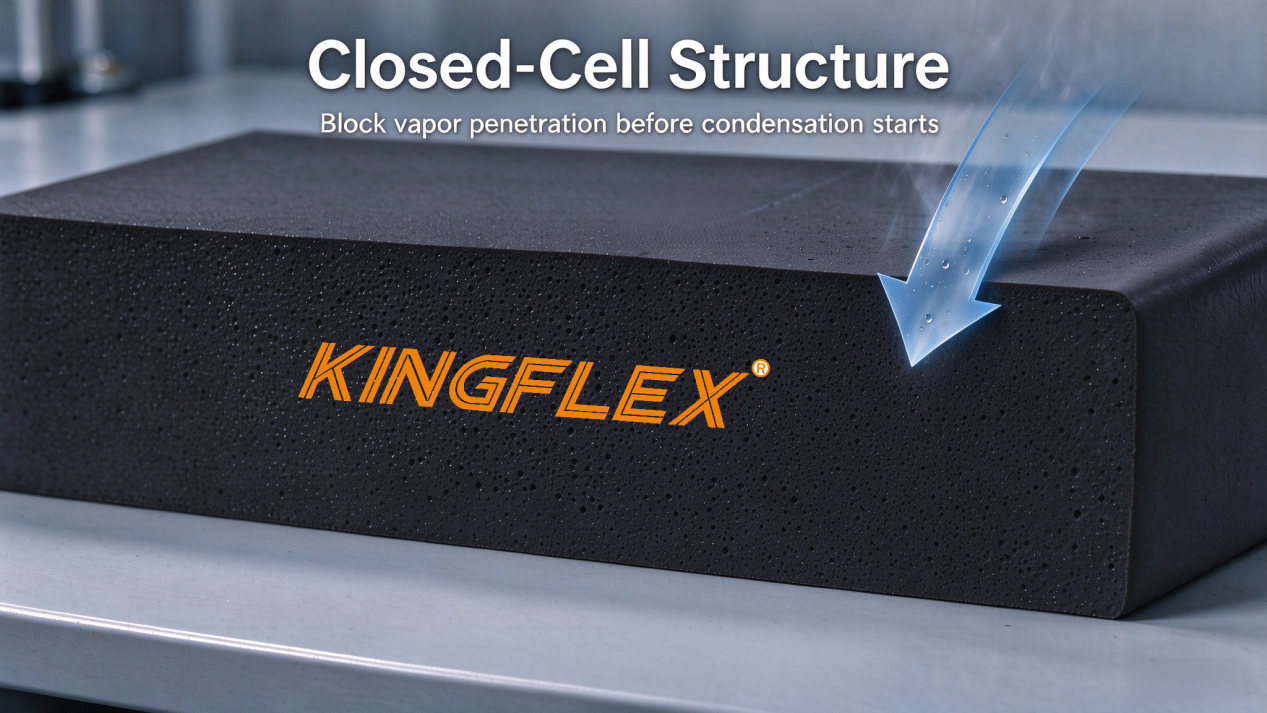
Closed cell construction is the foundation of anti-condensation rubber foam capacity. With High quality rubber foam, the sealed cells stay intact ,so water vapor can’t get through. Low cost inferior foam has broken cells and a large open cell ratio, which allowing vapor to seep continuously into the inside layer. After a few seasons, the foam soaks up moisture and gets heavier.Its thermal conductivity goes down fast, and the insulation stops working. Before purchase, you should request third party lab test reports and verify closed cell indicators to avoid low quality open cell foam.
Step 2:Confirm Fire Rating & Match Local Codes
Public building and data centre mechanical rooms across Europe, the Middle East and Southeast Asia enforce strict fire requirements. Class 0 or B1 rubber foam is widely adopted. Every region has its own building codes,and in some projects, high smoke materials are not allowed by ruler.So before ordering, take a second look at the test certificates and make sure they meet certain demands.If materials fail fire standards, they won’t pass fire inspection,and that means rework, plus major losses in time and money.
Step 3:Assess Working Conditions & Select Facing
For normal indoor mechanical rooms that stay dry, standard plain rubber foam sheets and tubes are good enough. For high humidity mechanical rooms, if your pipes are near outside walls or partly exposed, go with foil,faced rubber foam,it’s the better choice.Aluminium foil facings further boost vapor resistance, UV protection and aging resistance, extending service life. Special protective facings are available for mechanical rooms with oil contamination.
Step 4:Calculate Proper Insulation Thickness
Insulation thickness is not a fixed value. It depends on the pipe’s medium temperature, along with the surrounding temperature and humidity.The lower the medium temperature, the thicker the insulation needs to be.On low temperature chilled water pipes, if the insulation isn’t thick enough, the surface temperature can drop below the dew point.That’s why condensation forms and starts dripping.Many projects cut thickness to save upfront budget, but this causes severe condensation failures later. Ask your supplier to complete dew point calculation with your project parameters and recommend suitable thickness.
Step 5:Check Manufacturing Tolerance & Cutting Precision
Inferior rubber foam comes with uneven thickness and unstable dimensions for sheets and tubes. Gaps form widely after installation, leading to massive cold loss. Kingflex uses automated production lines for precision cutting with tight thickness tolerance. Tight joints help cut down on energy waste. When the joints fit tightly, you waste less energy.Custom tube sizes based on outer pipe diameter and custom sheet cutting are available on request.
Kingflex Mechanical Room Insulation Solution
Kingflex rubber foam insulation comes with full sets of test documentation and custom specifications. Our engineering team gives you the right direction based on the pipe temperature, ambient humidity, and local building codes.That helps you avoid common mechanical room insulation problems and keep the system operate reliably for years.
Conclusion & Contact Us
Choosing rubber foam insulation for your mechanical room involves five key checks: closed cell structure, fire rating, working conditions, thickness and tolerance. Stick to these steps, and you won’t have to deal with condensation, fire code issues, or insulation that wears out too fast.If you need dew point calculation, test certificates or specification consultation, contact us for professional support.
Post time: Oct-15-2026


